
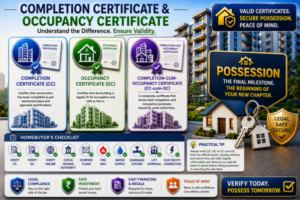
A Completion Certificate (CC) and an Occupancy Certificate (OC) confirm that the apartment or building complies with the sanctioned layout plan, building regulations, and safety norms. They also certify that essential civic infrastructure is in place for lawful possession and occupation. Despite legal importance of these certificates, most homebuyers often overlook these essential documents.
Table of Contents
Introduction
Homebuyers often assume that Completion Certificate and Occupancy Certificate are the same documents. Developers also frequently use these terms interchangeably referring to them briefly as CC and OC.
However, these are undoubtedly distinct certificates, each serving a specific purpose. Understanding this distinction is critical before taking possession, occupying the apartment or executing the Conveyance or Sale Deed. The certificates must be valid and issued by the competent authority.
Clarity on these certificates helps buyers make informed decisions, preventing buying a non-compliant property.
💡 Although based on Indian laws, this article is equally relevant for NRIs, OCIs, Persons of Indian Origin, and overseas investors interested in purchasing property in India.
Scope of this Article
This article is primarily focused on the legal importance of the Completion Certificate and Occupancy Certificate in multi-storey apartments and group housing projects. It covers the regulatory role of the Real Estate Regularity Authority under Real Estate (Regulation and Development) Act, 2016 and local authorities regarding the issuance of these certificates, with the aim of creating awareness among homebuyers.
Why This Distinction Matters?
Completion Certificate and Occupancy Certificate serve different legal and practical purposes and should never be treated as substitutes for each other.
- The Completion Certificate confirms that the building has been constructed as per the sanctioned plan, layout, specifications, and building regulations.
- The Occupancy Certificate certifies that the building is safe, habitable, and fit for occupation.
Possession of apartment followed by execution of Sale or Conveyance Deed, and property registration are directly related to these certificates.
Most banks require a valid OC for final home loan disbursement before possession, and local municipal authorities require it for regular utility connections and property tax assessment.
Under RERA Act, promoters are responsible for obtaining and handing over the Completion Certificate and Occupancy Certificates before delivering possession.
A clear understanding empowers buyers to verify all statutory and regulatory compliances before accepting possession.
Legal Insight: Supreme Court of India Directions
The Supreme Court of India has strongly emphasized the critical importance of Completion Certificate and Occupancy Certificate for homebuyers. In the matter of Rajeev Gupta and others vs. U.P. Avas Evam Vikas Parishad and others (Civil Appeal No. 14604 of 2024), the Apex Court issued multiple directions concerning CC and OC for implementation of PAN India..
The key directions concerning CC and OC are elaborated in Paragraph 21 (Pages 31–34) of the judgment.
Read the full judgment here: Supreme Court of India – Case Status
(Select Case Type: Civil Appeal → Case Number: 14604 → Diary Year: 2024)
Understanding Completion Certificate and Occupancy Certificate
What is a Completion Certificate?
Definition under RERA Act
Under section 2(q) of the Act, “Completion Certificate” means the completion certificate, or such other certificate, by whatever name called, issued by the competent authority certifying that the real estate project has been developed according to the sanctioned plan, layout plan and specifications, as approved by the competent authority under the local laws.
What is an Occupancy Certificate?
Definition under RERA Act
Under section (zf) of the Act, “Occupancy Certificate” means the occupancy certificate, or such other certificate by whatever name called, issued by the competent authority permitting occupation of any building, as provided under local laws, which has provision for civic infrastructure such as water, sanitation and electricity.
What is a Completion-cum-Occupancy Certificate?
In many states and Union Territories, only one composite certificate is issued. Section 2(q) and 2(zf) of the RERA Act use the phrase “by whatever name called.” Therefore, a single certificate that covers both aspects as defined under section 2(q) and 2(zf), satisfies the requirements under the Act.
Note: This clarification has been provided by the Ministry of Housing & Urban Affairs, Government of India under Frequently Asked Questions (FAQs) on RERA (updated up to July, 2025).
Other Certificate Terminology in Practice
Partial Completion Certificate (PCC)
Partial Completion Certificate is given for a completed portion, phase or block of a larger real estate project wherein the construction and services are found to be complete in accordance with the sanctioned plans and applicable building regulations. PCC is commonly for projects developed in more than one phases with different completion timeline. Once all phases are complete, the authority may issue a final Completion Certificate for the entire project.
Partial Occupancy Certificate (POC)
A Partial Occupancy Certificate (POC) is issued for a completed portion, phase or block where PCC has been issued after the competent authority is satisfied that it is fit for occupation, after due field enquiry. It enables the promoter to lawfully offer possession of that completed portion while the remaining project is still under development.
Legal Framework
Duties of Promoter under Section 11(4)(b)
Under the RERA Act, it is the promoter’s responsibility to obtain the Completion Certificate or Occupancy Certificate (or both, as applicable) and hand it over to the allottees.
Section 11(4)(b) of RERA Act states: The promoter shall
“be responsible to obtain the completion certificate or the occupancy certificate, or both, as applicable, from the relevant competent authority as per local laws or other laws for the time being in force and to make it available to the allottees individually or to the association of allottees, as the case may be.“
Competent Authority under RERA Act
Section 2(q) of RERA Act defines;
“Competent Authority” means the local authority or any authority created or established under any law for the time being in force by the appropriate Government which exercises authority over land under its jurisdiction, and has powers to give permission for development of such immovable property. It may vary across States.
Purpose of Completion Certificate and Occupancy Certificates
Purpose of Completion Certificate
A Completion Certificate is a vital legal document that certifies the construction has been completed in accordance with sanctioned building plans, approved specifications adhering to applicable regulations and safety norms.
Purpose of Occupancy Certificate
An Occupancy Certificate certifies that the completed building is safe and fit for habitation. It is issued only after verifying compliance with building codes, availability of basic amenities, and necessary NOCs (fire safety, structural stability, etc.) and after due field enquiry.
Homebuyers Journey: Booking to Legal Ownership
The following infographic indicates at what stage CC and OC become relevant for homebuyers.

Completion Certificate vs. Occupancy Certificate
| Aspect | Completion Certificate | Occupancy Certificate |
| Definition | Section 2(q) of RERA Act | Section 2(zf) of RERA Act |
| Objective | Confirms that the construction work has been completed in accordance with the approved plans. | This confirms that the property is ready for occupancy. |
| Issuing Authority | Local municipal authority or development authority | local municipal authority |
| Time of Issuance | issued after the completion of construction work. | It is issued after CC is issued and all safety checks and necessary civic facilities are in place. |
| Required For | Legal transactions such as the sale of property | Legal possession and rights over the property |
| Implications | Permits the legal sale and transfer of the property. | It grants permission to legally possess and use the property. |
Sequential Relationship
The Completion Certificate is obtained first after construction is completed as per sanctioned plans. Only after the CC can the promoter apply for the Occupancy Certificate, which confirms the building is fit for habitation with necessary civic infrastructure. Both CC and OC are essential and sequential. Without a valid OC, buyers cannot legally occupy the property.
Homebuyer’s Checklist
- Verify that a valid CC has been issued by the competent authority (wherever applicable).
- Verify that the OC has been issued before accepting possession.
- Check the authenticity of certificates on the official portal of the issuing authority.
- Confirm certificate relates to your specific tower, phase, and sanctioned plans.
- Verify supporting documents like Fire NOC, structural safety certificate, water supply, and sewerage, lift approval, and permanent electricity connection.
- Ensure the project land and details match the sanctioned layout plan, RERA filings and Agreement for Sale.
💡 Practical Tip: Never rely solely on the builder’s narration. Always obtain copies of Completion Certificate and Occupancy Certificate, verify them directly with the issuing authority or online portal, and cross-check that the project land details are accurate for calculating Undivided Share (UDS) before taking possession or executing the Sale Deed.
Read our detailed article on: Undivided Interest in the Common Areas and facilities (UDS)
Key Takeaways
- Completion Certificate and Occupancy Certificate are not the same but legally different. CC certifies completion and OC authorizes occupation.
- Always verify both certificates before possession. A valid OC is essential for lawful occupation.
- Verify the authenticity with the issuing authority or from the official portal.
- Proper verification prevents costly legal disputes later.
- Keep copies of both Certificates for record and future use.
Frequently Asked Questions (FAQs)
What is the main difference between an Occupancy Certificate and Completion Certificate?
A CC certifies that construction has been completed as per the sanctioned layout plans, whereas an OC certifies that the building is legally fit for occupation with essential civic infrastructure and safety standards.
Are these certificates are mandatory?
Their requirement depends on the applicable State laws and local building regulations. Where prescribed, both must be obtained from the competent authority. However certification is mandatory under RERA Act.
Can a builder handover possession without an Occupancy Certificate?
Generally, no. Where OC is required under local laws, the builder should not offer possession until a valid OC is issued. Doing so may violate RERA provisions.
What is a Completion-cum-Occupancy Certificate?
It is a single composite certificate issued by some authorities that serves the purpose of both CC and OC as defined under RERA Act.
What is a Partial Completion Certificate (PCC) and Partial Occupancy Certificate (POC)?
PCC is issued for a completed phase or block of a larger project. A POC permits lawful occupation of a completed phase or block, while the remaining project is still under construction.
Why is it important to verify CC and OC before taking possession?
Verification ensures the property is legally compliant, safe for living, and helps avoid future legal disputes, higher utility charges, or problems with home loans and resale. Always cross-check authenticity with the issuing authority or from on line portal.
Do Banks require Occupancy Certificate for home loan approval?
Most banks require a valid OC for the final disbursement of the home loan or accepting existing property as collateral security for a loan.
💡 Also Read: RERA Act 2016: Key Features, Benefits & Impact
Conclusion
In summary, the Completion Certificate and Occupancy Certificate play distinct yet equally important roles in property purchase and ownership in India. Both Completion Certificate and Occupancy Certificate serve different legal purposes and should never be treated as substitutes for each other.
Time spent on verification of authenticity of the certificates can protect buyers from legal disputes, financial losses, and regulatory complications in the future.
Legal Disclaimer
This article is intended for general informational and educational purposes only and does not constitute legal advice. The legal requirements for Completion Certificates, Occupancy Certificates, Completion-cum-Occupancy Certificate and issuing authority may vary depending on the applicable State laws, municipal building bye-laws, and local development regulations. Readers should verify legal validity of certificates before making any buying decision.
Your blog on Occupancy certificate or completion certificate is very useful material for the society. Great 👍 keep it up
Thank you so much for words of appreciation. Please share it further.
Your blog on Occupancy certificate or completion certificate is very useful material.
Thank you so much. Your suggestions also welcome for further improvement.