

Understanding your proportionate ownership in the project land and common areas and facilities for better legal protection and long-term investment value.
Table of Contents
Introduction
When purchasing an apartment in a multi-storey housing project, most people focus on sample flat, carpet area, price, discounts, preferential location, amenities and early possession. However, buyers often overlook one of the most valuable ownership rights attached to an apartment, namely, the undivided interest in the common areas and facilities, commonly referred to as Undivided Share of Land (UDS).
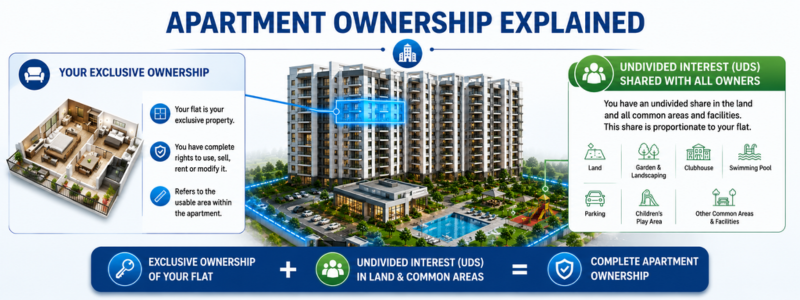
This proportionate interest in the project land and common areas forms an integral and inseparable part of apartment ownership.
It is different from Carpet Area, Built-up Area, or Super Built-up Area, which only measure the physical size of your flat. UDS determines the buyer’s legal ownership interest in the project land and shared spaces within the project.
Scope of this Article
This article focuses on multi-storey apartment projects where State Apartment Ownership laws apply in harmony with the RERA Act. These laws provide for ownership of an apartment together with undivided interest in the common areas, making the property a legal, heritable and transferable unit.
Note on Terminology
“Undivided Share of Land (UDS)” is a widely used market term. Legally, it is called “Undivided Interest in the Common Areas and Facilities”. Both expressions broadly describe the legal link that connects an apartment to the project land and forms the foundation of apartment ownership.
In this article, both terms are used interchangeably for easy understanding.
Legislative intent
The legislative intent is evident from the Preamble to the Punjab Apartment Ownership Act, 1995 (Act 13 of 1995), which states that the Act was enacted “to provide for the ownership of an individual apartment in a building together with an undivided interest in the common areas and facilities appurtenant to such apartment, to make such apartment and interest heritable and transferable.”
Readers may refer to the Punjab Apartment Ownership Act, 1995 (PAOA) available under the ” Rules, Acts & Notifications” section of the PUDA website. This statutory objective clearly recognises that an apartment is not merely a physical unit but a legally recognised immovable property inseparably linked with an undivided interest in the common areas and facilities.
Similar Apartment Ownership laws exist across several States of India. While this article uses the Punjab Apartment Ownership Act, 1995 for illustration, readers should refer to the corresponding law applicable in their respective State. Examples include:
- The Uttar Pradesh Apartment (Promotion of Construction, Ownership and Maintenance) Act, 2010
- The Haryana Apartment Ownership Act, 1983
- The Maharashtra Apartment Ownership Act, 1970
- The Delhi Apartment Ownership Act, 1986
- The Karnataka Apartment Ownership Act, 1972
- The Tamil Nadu Apartment Ownership Act, 1994
- The West Bengal Apartment Ownership Act, 1972
Genesis and Rationale behind Undivided Interest in the Common Areas
Historical Background
The concept of Undivided Share of Land (UDS) evolved with the rise of multi-storey apartment buildings with rising land prices and growing housing demand. It first gained importance in cities of South India like Chennai, Bengaluru, and Hyderabad, followed by Mumbai and other metropolitan cities, and high-density urban centres, where apartment ownership emerged as the predominant form of residential development and became an important consideration for apartment buyers. The concept became important because multiple apartment owners share the same parcel of land, which cannot be physically divided. UDS gives every buyer a clear proportionate share in the land and common facilities.
Legal Rationale
A building is considered immovable property because it is permanently attached to the land. In an independent house, the buyer owns both the house and the land beneath it. However, in apartments, the land is shared among many apartment owners and cannot be physically divided.
To solve this issue, State Apartment Ownership laws created a practical solution by giving each owner:
- Full ownership of the individual apartment, and
- An inseparable undivided interest in the common areas and facilities.
This legal structure ensures individual ownership of the apartment while sharing collective ownership of the land and common facilities in proportion to UDS.
⚖️ Legal Insight: An apartment becomes a legally recognised immovable property mainly because of this undivided interest in the land and common areas attached to it.
Why Undivided Interest in the Common Areas Matters?
Undivided Interest in the Common Areas is not just a technical term. It has a direct and significant impact on the financial interest and property rights of buyers. It gives proportionate ownership in the project land and common facilities to the buyers. A higher UDS usually means better long-term value, stronger resale potential, and greater redevelopment benefits.
Key Benefits of Undivided Interest in the Common Areas
- Stronger Ownership Rights — Buyers get a clear, legally recognised proportionate share in the project land and common facilities.
- Better Resale & Rental Value — Higher UDS makes the apartment more attractive to future buyers in case of resale.
- Higher Redevelopment Benefits — Buyers receive a larger share in any future redevelopment or compensation.
- Better Mortgage Value — Banks often consider apartments with higher UDS more favorably for home loans and as collateral security.
UDS versus Carpet Area – A simple Comparison
Many homebuyers confuse Undivided Interest in the Common Areas with Carpet Area. Though both are important, they serve very different purposes.
UDS (Undivided Interest in the Common Areas and Facilities) means the buyer’s proportionate ownership in the project land and common facilities.
Carpet Area means how much space you actually live in (the usable floor area inside your apartment, as defined under Section 2(k) of RERA).
Simple Rule to Remember:
The carpet area tells you “how much you can live in.”
UDS tells you “how much you actually own.”
How Is Undivided Interest in the Common Areas Calculated?
This is one of the most common questions buyers ask “If the entire project land is common, how is my share in it determined?”
The RERA Act recognises the common areas but does not specify the method for calculation of the undivided interest. This is usually governed by the respective State Apartment Ownership Act.
For example, Section 4(2) of the Punjab Apartment Ownership Act, 1995 (Punjab Act No. 13 of 1995) provides that:
“Every person who becomes entitled to the exclusive ownership and possession of an apartment shall be entitled to such percentage of undivided interest in the common areas and facilities as may be specified in the conveyance deed of apartment and such percentage shall be in the ratio of the built-up area of the apartment to the total built-up area of all the apartments of the building and in respect of the limited common areas and facilities reserved for the use of certain apartments to the exclusion of other apartments, such percentage shall be the ratio of the built-up area of the apartment to the total built-up area of those apartments for which the use is reserved.”
Illustrative Formula
Undivided Interest (%) = (Built-up Area of the Apartment ÷ Total Built-up Area of All Apartments) × 100
Important Note:
The Undivided Interest in the common areas (UDS) should ordinarily be calculated with reference to the entire project land, wherever applicable under the governing law and project documents, not just one tower. Always check this in your Agreement for Sale and Sale Deed.
Carpet Area under section 2(k) of RERA
Section 2(k) Statutory Provision
“Carpet area” means the net usable floor area of an apartment, excluding the area covered by the external walls, areas under services shafts, exclusive balcony or verandah area and exclusive open terrace area, but includes the area covered by the internal partition walls of the apartment.
How Does a Homebuyer Acquire an Undivided Interest?
A homebuyer acquires this right through three contractual and statutory provisions that operate together.
- Agreement for Sale (Form A or Form Q)
- RERA Act (especially Sections 2(n), 13 & 17)
- State Apartment Ownership Act
The Agreement for Sale is the most important document buyers sign before buying or booking an apartment. The Agreement for Sale acts as the primary contractual bridge between provisions under RERA Act and State Apartment Ownership laws.
Agreement for Sale-The Most Important Document
Agreement for Sale is the first and most important legally enforceable document executed between the promoter and the allottee. It is much more than a booking confirmation or a payment schedule. It is executed in the prescribed format under Section 13(2) of the RERA Act and the applicable State RERA Rules.
The Agreement for Sale records the allottee’s rights in the common areas and facilities, and the obligations of the promoter. Always read it carefully before signing.
Note on the Prescribed Agreement for Sale
As per Section 13(2) of RERA Act, the Agreement for Sale must be executed in the format prescribed and notified under the State RERA Rules. The name and format of this form may slightly differ from state to state. For example, in Punjab:
- It was first introduced as Form A in 2017.
- Later renamed and revised as Form Q in 2020.
- Further updated as Form Q in 2022.
These prescribed formats are available on the Punjab RERA portal under Documents Tab in Forms and Templates and analysed.
In this article, whenever Form-A or Form-Q is mentioned, it refers to the prescribed Agreement for Sale under the applicable State RERA Rules regardless of the exact name used in other states or UTs.
💡 Important Advice: Always insist on the official prescribed format of the Agreement for Sale. Do not accept any diluted or modified version.
Agreement for Sale: Key Clauses Governing Undivided Interest
Clause 1.8 – What Exactly Are You Buying?
This is one of the most important clauses in the Agreement for Sale notified under the RERA Rules. It clearly states:
(i) The Allottee shall have exclusive ownership of the Apartment/Plot;
(ii) The Allottee shall also have undivided proportionate share in the Common Areas. Since the share/ interest of Allottees in the Common Areas is undivided and cannot be divided or separated, the Allottee shall use the Common Areas along with other occupants, …………………………”
(iii) That the computation of the price of the [Apartment/ Plot] includes recovery of price of land, construction of [not only the Apartment but also] the Common Areas, internal development charges, external development charges, taxes, cost of providing electric wiring, fire detection and firefighting equipment in the common areas etc. and includes cost for providing all other facilities as provided within the Project.
The clause clearly establishes that the allottee is not just buying walls and floors but also paying for an inseparable undivided interest in the common areas and facilities.
Clause G – Pro Rata Share in the Common Areas
This clause clearly states that the allottee will receive a pro rata (proportionate) share in the common areas, as defined under Section 2(n) of RERA. Importantly, Section 2(n) clearly includes the entire land of the project as part of common areas.
💡 Legal Insight:
Clause G connects the allottee’s contractual rights (in the Agreement for Sale) with the “Common Areas” defined under Section 2(n) of RERA Act. This ensures the buyer’s undivided interest in the common areas and facilities is properly established.
Applicability of the State Apartment Ownership Act
Clause 19 of the Agreement for Sale states:
“The Promoter assures that the Project in its entirety is in accordance with the provisions of the applicable State Apartment Ownership Act and is complying with the applicable laws and regulations.”
Simple Explanation
Clause 1.8 confirms that the buyer is entitled to exclusive ownership of the apartment plus undivided share in common areas. The price of an apartment also includes the cost of land and common facilities provided within the project.
Clause G links buyer’s share to the definition of Common Areas under section 2(n) of RERA, which includes the entire project land.
Clause 19 of the Agreement for Sale assures that the project complies with the State Apartment Ownership Act in entirety.
⚖️ Legal Insight: Together, these provisions establish the contractual and statutory basis through which an allottee acquires an apartment together with inseparable undivided interest in the common areas and facilities.
Key RERA Provisions
What Are Common Areas under Section 2(n) of RERA?
Section 2(n) of RERA Act, 2016 defines “Common Areas” and specifically includes;
The entire land for the real estate project or the entire land for that phase, where the project is developed in phases and registration under this Act is sought for a phase.
Important Point: This means the buyer’s undivided interest in common areas and facilities applies to the whole project land, not just the land under the footprints of the tower.
Section 13 of RERA Act – Agreement for Sale
Statutory Provision Section 13(2)
The Agreement for Sale referred to in sub-section (1) of section 13 shall be in such form as may be prescribed and shall specify the particulars of development of the project including the construction of building and apartments, along with specifications and internal development works and external ……………….”
Section 13(2) of RERA Act makes the Agreement for Sale a statutory document. It must be executed in the prescribed Form (Form Q) notified by the State under RERA Rules. This is the principal document that records the allottee’s rights, including undivided share of land (UDS).
Section 17 – Transfer of Title
Section 17(1) – Conveyance of Title and Possession
Statutory Provision Section 17(1)
“The promoter shall execute a registered conveyance deed in favour of the allottee along with the undivided proportionate title in the common areas to the association of the allottees or the competent authority, as the case may be, and hand over the physical possession of the plot, apartment of building, as the case may be, to the allottees and the common areas to the association of the allottees or the competent authority, as the case may be,……………..”
Explanation
Section 17(1) prescribes the promoter’s principal obligations upon completion of the project. It requires the promoter to execute a registered conveyance deed in favour of the allottee, complete the statutory transfer of the common areas to the Association of Allottees or the Competent Authority, as applicable, and hand over the physical possession of the apartment together with the relevant title documents within the time prescribed under the applicable local laws.
Section 17(2) – Handover of Project Documents and Plans
Statutory Provision 17(2)
“After obtaining the occupancy certificate and handing over physical possession to the allottees in terms of sub-section (1), it shall be the responsibility of the promoter to hand over the necessary documents and plans, including common areas, to the association of the allottees or the competent authority, as the case may be, ……….”
Explanation
Section 17(2) of the Act complements the obligations contained in Section 17(1). After obtaining the Occupancy Certificate and handing over possession, the promoter is required to deliver the necessary documents and plans relating to the project, including the common areas, to the Association of Allottees or the Competent Authority, as the case may be, in accordance with the applicable local laws.
At this stage, the duly elected and registered Association of Allottees or Residents Welfare Association ordinarily assumes responsibility for the management and maintenance of the project in accordance with the applicable state laws and declarations.
Legal Clarification
Even though Section 17(1) requires the promoter to transfer the common areas to the Association, the collective ownership remains with all apartment owners through their undivided interest (UDS). The Association of Allottees only manages and maintains the common areas on behalf of the owners, without having ownership rights.
Legal Consequences of Completion and Handover
Once the project is completed and management is handed over to the registered RWA, as per law, the builder’s role as a developer ends.
According to section 15(1) of the Punjab Apartment and Property Regulation Act, 1995 (PAPRA Act, 1995):
- The promoter loses all special rights over the project.
- If the builder still owns any unsold apartments, they are treated as a normal apartment owner, with the same rights and obligations as other allottees have.
- The builder has no superior rights over the common areas just because they developed the project.
⚖️ Legal Insight: After completion and handover of project, the collective ownership of the common areas and facilities belongs to all apartment owners through their undivided interest (UDS). The Residents Welfare Association (RWA) or Association of Allottees only manages and maintains these areas on behalf of all the owners. The builder no longer has any special control over the project.
Meaning of “As the Case May Be”
The expression “as the case may be” recognises that RERA governs different categories of real estate projects. Accordingly, the manner in which title, possession and common areas are transferred may vary depending upon the nature of the project and the applicable State or local laws.
Simple Examples:
In a regular apartment building: The promoter executes Sale Deeds in favour of individual buyers and transfers the common areas to the Association of Allottees (RWA). However, the collective ownership of the common areas remains with all apartment owners through their undivided interest. The Association manages and maintains these areas on behalf of the owners.
In plotted developments: Roads, parks, and open spaces are usually handed over to the local Municipal Corporation or Development Authority.
In large townships or mixed projects: Some common facilities may be transferred to the Association, while certain shared amenities may be managed by a larger body or competent authority as per the approved plan.
In simple words: The law provides flexibility. In most apartment developments, the common areas are transferred to the RWA for management, but the actual ownership stays collectively with all apartment owners in proportion to their UDS. The Association does not own the common areas — it only represents the owners.
⚖️ Legal Insight: Sections 2(n), 13 and 17, read together with the Agreement for Sale and State Apartment Ownership laws, provide a complete framework governing common areas, the Agreement for Sale and the promoter’s post-completion obligations.
Legal Interpretation & Analysis
Section 17 of RERA has two important and complementary parts:
- Section 17(1) principally deals with the execution of the conveyance deed, handing over possession and completing the transfer-related obligations concerning the common areas in accordance with the applicable law.
- Section 17(2) requires the promoter to hand over the plans, approvals, title documents and all other project records to the Association of Allottees or the Competent Authority to facilitate the future management and administration of the project on behalf of the allottees.
Key Distinction: Section 17(1) primarily concerns ownership, conveyance and possession, whereas Section 17(2) deals with the handover of project documents and records. Together, these provisions complete the promoter’s post-completion obligations under RERA and ensure a smooth transition from development of the project to owner-led management.
Practical Issues & Common Builder Practices
Restricting UDS to Tower Footprint
Some builders calculate UDS only based on the land under one tower, instead of the entire project. This can significantly reduce the buyer’s ownership share in the land and common facilities. Always verify that UDS is based on the entire land of the project.
Ambiguity in Sale Deeds
Many Sale Deeds mention the apartment but give vague or unclear details about undivided share of land (UDS). Buyers should ensure that the Sale Deed clearly mentions undivided share of land as mentioned in the Agreement for Sale.
Delay in Transfer of Common Areas
Builders sometimes delay transferring common areas and all the project and title documents to the duly registered Association of Allottees. This can create problems for RWA in managing the society.
Maintenance Hand over versus Ownership
Simply handing over maintenance to the RWA is not the same as transferring ownership. The RWA manages and administers the common areas, but ownership collectively remains with all apartment owners through their undivided share of land (UDS).
Limited Buyer Awareness
Most buyers focus only on carpet area, price, and amenities. Very few carefully check the UDS in the Agreement and Sale Deed. This lack of awareness and due diligence often leads to disputes later.
Homebuyer’s Checklist before Executing Sale Deed
- Read the Agreement for Sale carefully.
- Check the exact UDS percentage and whether it covers the full project.
- Compare Sale Deed with Agreement for Sale.
- Verify that the project complies with the applicable State Apartment Ownership Act.
- Ensure common areas and documents are properly transferred to the Association.
💡 Practical Tip: Buyers should review the UDS details in the Agreement for Sale and final Sale Deed before signing. Clarify any doubts before registration to prevent future disputes. Verifying these documents before execution is far easier than resolving disputes after registration.
Conclusion
Apartment ownership is fundamentally different from owning an independent house. When you purchase an apartment, you are not just buying walls and floors — you are also acquiring a legal undivided interest (UDS) in the project land and common facilities. This proportionate share in the land and common areas forms an essential part of your ownership rights and long-term value, resale potential, and redevelopment benefits. Verifying UDS in the Agreement for Sale and the final Sale Deed is one of the smartest steps buyers can take to safeguard their interest.
A clear understanding of rights under RERA and State Apartment Ownership laws is a must to protect buyers from future disputes and help you make a more informed investment decision.
To learn more about the rights of homebuyers and protections available under the RERA Act, read a detailed article on the Benefits of the RERA Act.
Frequently Asked Questions (FAQs)
Is Undivided Share of Land (UDS) defined under RERA?
RERA does not define “UDS”. It is a popular industry expression. RERA recognises the concept through provisions relating to the undivided proportionate interest in the common areas.
Are UDS and Undivided Interest in the Common Areas the same?
Yes, in practice the two expressions are commonly used interchangeably. UDS is the market term; “undivided interest in the common areas and facilities” is the legal expression.
Can a builder restrict UDS only to the land beneath one tower?
Generally not ideal. However, it depends on the project documents and law. In multi-tower projects, UDS should be based on the entire project land as recognised under Section 2(n) of RERA Act. Always verify this early in the Agreement for Sale.
Is handing over maintenance the same as transferring ownership of the common areas?
No. Maintenance hand over is only for day-to-day management. Legal ownership of common areas is transferred through the Registered Document.
Is UDS mentioned in the Sale Deed?
Yes. It should be clearly mentioned in percentage or absolute numbers. Always cross-check it with the Agreement for Sale before signing the sale deed.
Does a higher UDS increase the value of an apartment?
Generally yes. Higher share in project land improves long-term value, resale potential, and redevelopment benefits since land appreciates over time.
Can UDS be sold separately from the apartment?
No. UDS is inseparable from the apartment. It cannot be sold or transferred independently.
Does RERA override the State Apartment Ownership Act?
No. Both laws complement each other in harmony. RERA regulates the transaction, while State Apartment Ownership Acts provide ownership of apartments along with undivided interest in common areas and facilities.
Legal Disclaimer
This article is intended solely for general information and educational purposes. It does not constitute any legal advice. Laws and interpretations may vary from state to state. Readers are advised to consult a qualified lawyer or legal expert for advice specific to their case and project. The author and publisher shall not be liable for any loss or damage arising from the use of this information.
References to the Punjab Apartment Ownership Act, 1995, the Punjab Apartment and Property Regulation Act, 1995 (PAPRA), and the Punjab RERA Rules have been used for explanatory purposes. Similar provisions may exist under the corresponding laws of other States.
Very informative article
Thank you so much.
A valueable article highlighting that undivided interest in the common areas is a statutory ownership right, not a privilege .It will protect the appartment owner against arbitrary action by the developers and associations. 👍👍
Thank you so much for your appreciation and valuable insight.
An in-depth and highly informative piece.
Thank you so much.
This article is a must-read for apartment owners. It explains that your share in the building’s common areas is a legal right you own, not a favor given to you. Knowing this helps protect you from unfair rules or decisions made by developers and management committees.
Thank you so much Ankit Ji for your encouragement.
Very informative article.
Thank you so much for words of appreciation. Please share it further.
“A well-written and insightful blog. The content is easy to understand and very helpful for anyone planning to buy a property.”
Thank you so much for words of appreciation. Please share it further.
Ok