
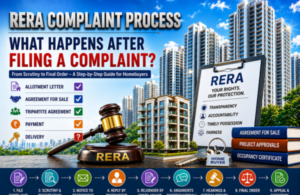
Filing a complaint with the Real Estate Regulatory Authority is the start of the legal process. Once filed, it passes through the RERA Complaint Process.
The complaint moves through scrutiny, notice issuance, hearings, interim orders, final order, and possible appeal or execution of order. This article explains each stage of the RERA complaint process in simple terms to help homebuyers know what to expect next. While every complaint is unique, the overall RERA complaint process follows these standard stages.
Table of Contents
Introduction
Although RERA has jurisdiction over a wide range of disputes under the Act, between the promoters and allottees, the overwhelming majority of complaints filed across India relate to delayed possession of property, followed by refund claims, interest for delay, construction defects, deviations from sanctioned plans, and other breaches of the Agreement for Sale. The RERA Complaint Process is summary in nature and it has remained a curiosity for homebuyers, what happens after filing a complaint.
Institution of complaint
- File the complaint online under Section 31 of the RERA Act on the Authority’s official website using the prescribed form and procedure. Follow steps and practical tips as broadly explained in our Article How to File a Complaint under RERA: 7-Step Practical Guide (2026).
- Submit a hard copy of the complaint (with documents signed, paginated and indexed) and additional copies of complaint equal to the number of respondents to the Registry.
- Provide two extra sets if the matter is to be heard by the larger Bench or Full Bench of the Authority.
Scrutiny and Registration of the Complaint
The Secretary or authorized officer of the Registry scrutinizes the complaint for fees, use of appropriate form (Form M or N), and compliance with RERA Rules. For the benefit of homebuyers and readers, link to Punjab RERA Rules i.e. “Procedure for handling complaints and related matters” has been provided.
Removal of Defect
If defects are found during scrutiny, the complainant is given reasonable time as per RERA Rules to rectify them. The complainant must request the Registry to return the online complaint first, make the necessary corrections, and resubmit it. Hard copies also need to be submitted again after rectification. If defects pointed out are disputed by the complainant, the matter is placed before the Authority for appropriate directions. Substantial defects, if not rectified may result in the complaint not being processed further.
Practical Insight: After submitting the complaint online, but before printing and preparing hard copies sets, confirm from the RERA office that the complaint submitted online is complete and in order. This simple verification step can save significant time, effort and printing cost by allowing you to rectify any deficiencies before filing the physical copies.
Registration of the Complaint
Once the complaint is found in order, the complaint is registered and assigned a unique complaint number. This unique case number is usually generated at the time of online submission of complaint.
Entrustment of Complaint
After registration, the complaint is assigned to a single Member Bench on a random basis, if there is more than one member. Normally the Authority is composed of a Chairperson and two members.
Complex matters may be referred to the Full Authority or transferred between Benches by the Chairperson, on a request from a single-Member Bench or Suo moto for appropriate reasons recorded.
Composition of Authority
Under section 21 of the Real Estate (Regulation and Development) Act, 2016, the Authority shall consist of a Chairperson and not less than two whole time Members to be appointed by the appropriate Government.
Maintainability of complaint
The assigned Member reviews the complaint and prima facie satisfies himself about its maintainability before issuing notice to the respondents.
Service of Notice to the Respondents
Issue of Notice
After registration, RERA issues notice to the respondent(s) on a prescribed format along with a copy of complaint and documents directing the respondents to appear on the date fixed for and file a reply and serve a copy to the complainant. The complainant is also intimated to appear on the date fixed for.
Service of Notice
Notices are served via registered/speed post, email, RERA portal, or approved courier. Separate notices are issued to multiple respondents.
In practice, delays often start at this stage due to non-service of notice. This usually happens because of incorrect addresses, change of address, or unavailability of some of the respondents at the given address.
Practical Insight: In case of non-service of notice, request the Authority to direct the Registry to affect Dasti service. Apply for Dasti service through the Process Server and provide updated addresses from RERA portal, MCA records, or other reliable sources to expedite the RERA complaint process. With the assistance of the assigned Process Server, arrange to serve notice Dasti as soon as possible. In RERA proceedings, “Dasti” simply means notice served by hand.
Filing of Reply by the Respondents
Respondents must file a written reply to the complaint within the stipulated time, personally or through a duly authorised representative. A common reply is usually filed when multiple respondents (promoter + directors or partners) are involved.
Contents of the Reply
- Preliminary objections (jurisdiction, limitation, maintainability)
- Paragraph-wise response to allegations
- Statement of facts and legal defences
- Supporting documents and prayer for dismissal
Banks or Housing Finance Companies financing the property (impleaded as proforma parties) file separate replies raising preliminary objections like lack of cause of action and misjoinder of parties or contention that no relief has been claimed against it.
How to Analyze the Reply
Analyze the reply point wise, para wise for admissions, contradictions, and new facts and evasive replies and raising false allegations to prepare an effective rejoinder.
Common Defence Raised by Promoters
- Force majeure or delay due to late approvals.
- Payment defaults by allottee.
- Regularisation under government notifications.
- Reasons beyond control.
Filing of Rejoinder by the Complainant
The complainant may file a rejoinder to rebut the reply. It should be concise, paragraph-wise, evidence-based, and limited to issues raised in the reply while maintaining consistency with the original complaint.
Practical Tip: Focus on answering the reply by the respondents rather than repeating the complaint. Keep it concise, consistent, evidence-based and focused. Any technical objections relating to jurisdiction, and maintainability, or limitation should also be specifically addressed. Check the rejoinder thoroughly before submission.
Hearing before the Regulatory Authority
After completion of pleadings (complaint, reply, and rejoinder), the case is listed for hearing for arguments. RERA follows summary proceedings based on principles of natural justice and fair adjudication. Parties may appear in person, through an advocate, or authorised representative. The Authority may seek clarifications, examine documents and frame issues. Depending upon case complexity of the case, one or more hearings may be required. Justified adjournments can be granted, but unnecessary delays by the respondents should be contested.
Practical Tip: Maintain a well-organised file containing all pleadings, a chronology of events, and supporting documents with important pages flagged. Focus on key issues during arguments, written or oral, and support your submissions with relevant documents and legal provisions.
Filing Additional Documents and Evidence
During proceedings, if need arises, parties may seek permission to file additional relevant documents or evidence with an application explaining their necessity. Either party may also file interim/miscellaneous applications seeking temporary relief or directions (e.g., production of documents) to protect rights pending adjudication. The Authority may pass interim orders after brief hearing where justified.
Arguments Stage (Written & Oral)
The Authority may direct parties to file written arguments summarising facts, issues, documents, and legal provisions, and precedents (without introducing new evidence). This is followed by oral submissions where parties briefly explain their case and respond to the Authority’s queries.
If after filing of written arguments by the complainant, the respondents also file written arguments, then the complainant must pray before Authority to allow filing rebuttal to such arguments and bring on record fresh documents required for specific rebuttal of averments by respondents.
Interim Orders and Order Sheets
The Authority may pass interim orders, if required. The order sheet records brief proceedings, appearances, directions, and next hearing dates.
Practical Insight: The complainant can view case status from RERA portal to ascertain case details, history of case hearing, case transfer details and also view order sheets. Download and analyze the contents of the order sheets minutely. Comply with the directions, and if there is error apparent on the record, immediately file an application under section 39 of the Act for rectification. This is important as order sheets create a legal record of proceedings and may lead the Authority to arrive at wrong conclusions at the time of deciding the main complaint. For the benefit of homebuyers and readers, link to RERA Punjab portal for understating “Search Case Status” has been provided.
Final Order under Section 31
After considering all material placed on record and arguments, the Authority passes a reasoned final order under Section 31, which may grant refund, interest, compensation, possession, directions for compliance, or may dismiss the complaint. A copy is of detailed order is uploaded on the RERA portal. Apply for a certified copy of order by immediately by depositing requisite fee.
Compliance with the Final Order
Comply within the stipulated timeline given by the Authority. Non-compliance allows execution proceedings. Aggrieved parties may appeal to the Real Estate Appellate Tribunal (REAT) established under the RERA Act as Appellate Tribunal.
Practical Tip: Review the order immediately for reliefs, timelines, and next steps. Maintain complete case records for execution or appeal. In most of the cases reliefs are given under section 18 of the RERA Act related to payment of interest on account of delay in possession or allottee opting out of the project. The compensation part is taken care of by the Adjudicating Officer.
If the decision is in favour of complainant, the respondent may prefer an appeal. It is advisable to file Caveat under Section 148A of the Code of Civil Procedure, 1908 (CPC) immediately after the order. A caveat requires the appellate court to give you an opportunity of being heard first before passing any order.
Practical Safeguards and Alerts for Complainants
- Practical Safeguards for Complainants in RERA Complaint Process
- Attend hearings or arrange proper representation
- File rejoinders and documents promptly
- Preserve proof of service and all communications
- Number annexures correctly and avoid suppressing facts
- Maintain a hearing diary and spare document sets
- Strictly follow Authority timelines
Keep scanned copies of all the filings, documents and order sheets of proceedings always ready for future course of action, if needed.
Frequently Asked Questions
Is my personal presence required on every date of hearing?
No. A complainant may appear through an advocate or authorised representative.
Can I file additional documents after filing the complaint?
Yes, with the Authority’s permission if they are relevant for adjudication.
Is filing a rejoinder mandatory?
Not always, but advisable when the reply raises new facts or strong defences.
Can I amend my complaint after filing it?
Minor amendments may be allowed with leave of the Authority, subject to state RERA Rules.
Can I cite Court Judgments?
Yes. Relevant Supreme Court, High Court, or RERA/REAT precedents can be cited reproducing relevant parts.
How long does the RERA complaint process take?
The Act aims for disposal within 60 days, but actual timelines vary based on case complexity and Authority workload.
“Bench Assigned” Meaning in RERA: What Does It Mean?
After the complaint is submitted online on RERA portal, the required number of copies of the complaint are submitted to the Registry. After the initial administrative and legal scrutiny by the Registry, the complaint is assigned to a specific Bench for further proceedings, hearings, and adjudication. The Bench may be headed by a Member, the Chairperson, or may comprise a Full Bench of the Authority, depending on the nature of complaint.
Conclusion
The RERA Complaint Process under Section 31 enables readers to understand Speedy Dispute Redressal Mechanism for resolving homebuyer disputes. Success depends on proper filing, timely follow-up, strong evidence, and adherence to procedural requirements. Understanding each stage helps complainants protect their rights effectively.
Disclaimer
This article is for general information only and is not a substitute for professional legal advice. Always refer to the RERA Act and state-specific RERA Rules.
Call to Action
If you found this “RERA Complaint Process” guide valuable and helpful, please share it with other homebuyers who may benefit from it. Your comments, suggestions, and experiences are always welcome. You may also explore our articles on RERA.
Good one 👍
Thanks a lot.